Desert Dunes Update is finally here for Raise Animals Roblox. Here are the patch notes covering new codes, Desert Biome, Animals, and more.
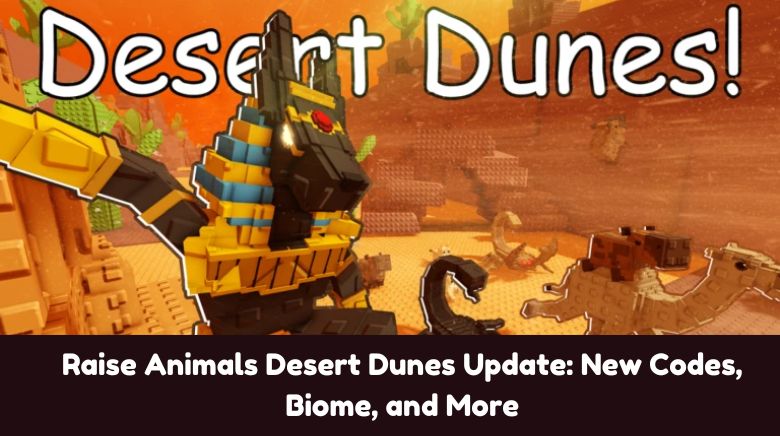
Raise Animals Desert Dunes Summary
Update 4 introduces the Desert Dunes biome, a scorching new region filled with sandstorms, hidden oases, new animals, and environmental challenges. Players can participate in the Oasis Revival event, encounter brand-new weather types, decorate their zoos with new items, and watch out for new moving obstacles. A refreshed Daily Wheel reward and multiple additions round out this major expansion.
Raise Animals Desert Dunes Update: Guide to unlock the Desert Dunes Biome
The Desert Dunes biome becomes available once you access the world map. From the main menu, press Play, open the Map, and scroll until you find the Desert Dunes region. It can be unlocked immediately by purchasing it for $7.5 million. There are no level gates, quests, or hidden requirements—once you buy it, the biome becomes a permanent part of your map and can appear at random during your runs.
Gameplay of the Desert Dunes
Desert Dunes introduces a mix of hazards that differ from the typical static obstacles found in other environments. While rocks, cactus clusters, and ancient statues behave like normal barriers, this biome mixes in moving elements that demand more awareness.
Biome Features to Watch Out For
- Tumbleweeds
These roll unpredictably and can drift into your path without warning. Treat them like moving traps rather than scenery. - Quicksand
Slows momentum significantly. Losing speed here often leads to forced collisions if another animal is close behind. - Dense Obstacle Placement
Stone formations and cactus blocks appear more frequently compared to other regions, making this biome more difficult to navigate.
Raise Animals Desert Dunes Update: Animals Found in the Desert Dunes
All animals in this biome share similar base speeds, but their passives define how dangerous or valuable they are. Below is a fresh breakdown categorized by rarity.
Basic Tier
Lizard
- Speed: 17–19
- Passive: None
Rare Tier
Sand Scorpion
- Speed: 17–19
- Passive: None
Desert Lark
- Speed: 17–19
- Passive: None
Epic Tier
Sidewinder Snake
- Speed: 17–19
- Passive: Spits venom every 10 seconds, poisoning the animal directly in front. Poisoned animals move slower and are instantly devoured on contact.
Fennec Fox
- Speed: 17–19
- Passive: None
Legendary Tier
Sand Cat
- Speed: 17–19
- Passive: Gains a 30% speed burst every 15 seconds for 5 seconds and marks nearby animals. Marked targets are devoured if your Sand Cat touches them.
Dromedary Camel
- Speed: 17–19
- Passive: Gains an extra 5% speed every 5 seconds while in the Desert biome, stacking up to 5 times. At max stacks, ignores terrain-related debuffs completely.
Rainbow Tier
Deathstalker Scorpion
- Speed: 17–20
- Passive: Burrows underground for 5 seconds, doubles movement speed, and becomes untouchable by collisions or crashes.
Shine Tier
Pharaoh Eagle
- Speed: 17–19
- Passive: Once its passive bar fills, it performs a dash and summons three sandstorms that slow nearby animals.
Exclusive Tier
Anubis
- Speed: 17–19
- Passive: Devours the closest animal every 2 seconds. Each devour triggers a sandstorm that inflicts Fear and slows rivals. Anubis and the rider gain brief invulnerability after each devour.
Earning Water Drops
Water Drops are the currency tied to Desert Dunes progression. To collect them, catch desert animals and place them in your zoo. Every desert animal generates Water Drops automatically every 5 minutes.
Water Drop Production Table
- Lizard – 5 per cycle
- Sand Scorpion – 10 per cycle
- Sidewinder Snake – 10 per cycle
- Fennec Fox – 25 per cycle
- Sand Cat – 40 per cycle
- Dromedary Camel – 40 per cycle
- Desert Lark – To be announced
- Deathstalker Scorpion – To be announced
- Pharaoh Eagle – To be announced
- Anubis – To be announced
Water Drops are used during the Oasis Revival event to purchase the exclusive desert animal (Anubis) and themed decorations.
Zoo Decorations and How to Obtain Them
Decorations are limited, but fences can be customized through the Lasso Gacha system.
Available Fences in Zoo Customize
- Default Fence – 50%
- Metal Fence – 35%
- Wood Fence – 35%
- Modern Fence – 10%
- Stone Fence – 4%
You can also purchase the Bone Fence from the Oasis Revival event for 20,000 Water Drops.
To apply a fence:
- Open Zoo Customize next to the Inventory button.
- Select the fence you want from the list.
- Save and exit to apply it across your zoo.
Raise Animals Desert Dunes Update FAQ
Q: Can Anubis spawn naturally?
A: Yes. Anubis has a very low natural spawn rate in the Desert Dunes biome, but it is catchable. You can also obtain it directly through the Oasis Revival event for 60,000 Water Drops.
Q: Does the Pharaoh Eagle need special conditions to appear?
A: No. It can appear randomly while running the Desert Dunes biome. Its Shine rarity simply makes it uncommon.
Q: How do I get the Capybara?
A: The Capybara is classified as an Ocean animal but does not spawn in the Ocean biome. It is only available through the Daily Wheel, replacing the Golden Lion in the rewards.
New Codes
Two new codes were added in the Raise Animals Desert Dunes Update. These two codes are: DesertDunes! and SorryForDelay. For older codes, head to our Raise Animals Codes tracker page.
So that’s it for now in this post on Raise Animals Desert Dunes Update: New Codes, Biome, and More.
Related:
Follow Us On Social Media:
how to get to desert??